
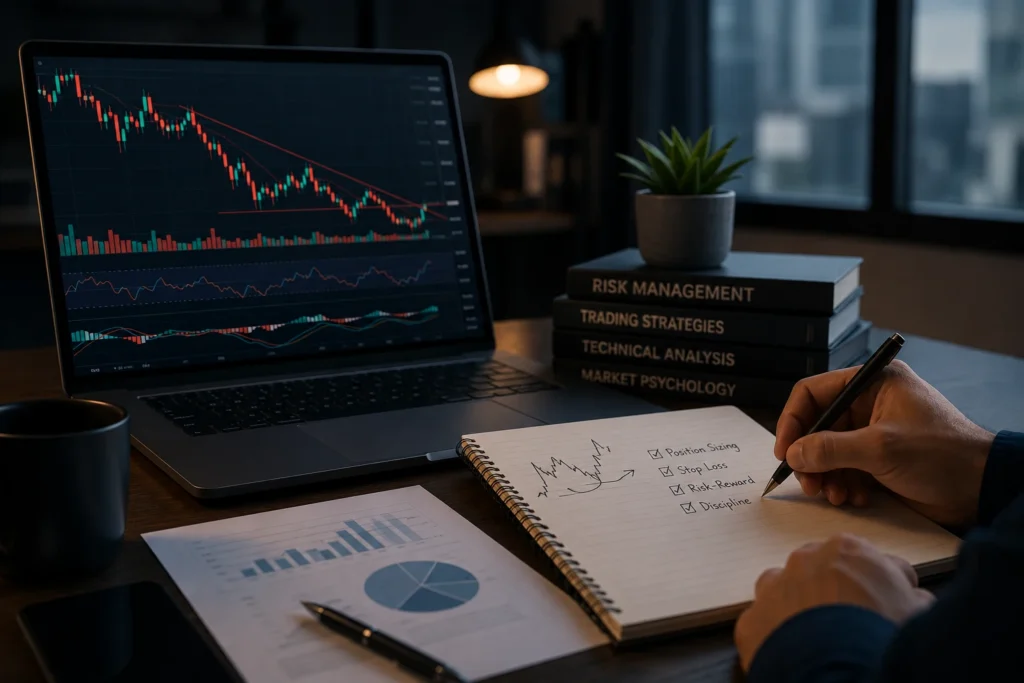
Many people enter the stock market focusing mainly on profits, targets, and market opportunities. While earning opportunities are an important part of trading and investing, one of the most overlooked aspects of long-term success is risk management.
Professional traders understand that protecting capital is often more important than chasing quick returns.
At Bhaskar Trading Academy, we believe risk management is one of the strongest foundations of disciplined market participation.
What Is Risk Management?
Risk management refers to the process of controlling potential losses while participating in financial markets. Since market movements are never fully predictable, every trade or investment carries some level of risk.
Proper risk management helps traders:
- reduce emotional decision-making,
- avoid unnecessary exposure,
- protect trading capital,
- and maintain consistency over time.
Without risk management, even good market strategies can become difficult to sustain.
Why Beginners Often Ignore Risk
Many beginners enter the market after seeing quick-profit stories or social media content focused only on gains. This often creates unrealistic expectations and encourages overtrading or high-risk decisions.
Common mistakes include:
- trading without stop-loss planning,
- investing large amounts in a single trade,
- emotional buying and selling,
- and ignoring market volatility.
Over time, these habits can lead to inconsistent performance and avoidable losses.
Key Principles of Risk Management
1. Position Sizing
Avoid risking too much capital on a single trade. Proper position sizing helps control losses and improves long-term sustainability.
2. Stop-Loss Discipline
Using stop-loss levels helps traders limit downside risk and avoid emotional decision-making during sudden market movements.
3. Risk-to-Reward Planning
Before entering a trade, it is important to evaluate whether the potential reward justifies the possible risk involved.
4. Emotional Control
Fear, greed, and impatience often influence trading decisions. Maintaining discipline and following a structured plan is essential.
5. Continuous Learning
Markets constantly evolve. Traders who continue learning and adapting are often better prepared to manage changing market conditions.
The Role of Technical Analysis
Technical analysis and chart-based learning can help traders identify:
- trends,
- support and resistance zones,
- entry and exit levels,
- and market momentum.
At Bhaskar Trading Academy, we focus on practical chart analysis and structured learning approaches designed to improve market understanding and disciplined decision-making.
Technology & Market Support
Modern trading technologies, analytical tools, and market software solutions can also support better decision-making by improving analysis efficiency and market monitoring.
Combining education with technology creates a stronger and more informed trading approach.
Final Thoughts
Successful trading is not only about finding opportunities — it is about managing risk responsibly and maintaining consistency over time.
Markets will always involve uncertainty, but disciplined planning, proper learning, and controlled decision-making can help traders approach the market with greater confidence and stability.
At Bhaskar Trading Academy, we encourage learners to focus on knowledge, discipline, and risk awareness as the foundation for long-term market growth.